
democrat – (n)
1. an advocate of democracy
2. a person who believes in the political or social equality of all people.
3. Politics – a member of the Democratic party.
Where is our party?
We are watching the political and economic landscape of this country change around us as the standard of living for the working and the “middle class” rapidly decreases while, at the same time, the wealth of the top 1% and the largest corporations grows exponentially and we are forced to ask, “Where is our representation?”
We feel the pain as we are evicted from our homes, laid off from our jobs and bankrupted by unsustainable health care costs. If we do maintain employment, we see our benefits being reduced, our ability to negotiate collectively being sacrificed and our salaries frozen or decreased. We feel the crush of mounting debt as we try only to maintain a moderate lifestyle and provide for our families and we call out, “Where is our voice in government?”
We witness the whittling away of our nation’s social programs while more and more of our fellow citizens find themselves in desperate need of assistance. We face the reality that one in four American children are today living in poverty. That point begs repeating: 25% of our nation’s children live in poverty. We say goodbye helplessly as our neighbors and our relatives bravely sign up with our Armed Services and are sent to die or suffer wounds in pointless, never-ending, outrageously expensive wars that no one wants. We see and feel all of this and we stand on our rooftops and look toward Washington and yell, “Who there stands for us while these decisions are being made, while these offenses are being perpetrated against us?”
The silence is deafening.
There is no political party representing the working class or the “middle class” today. The lack of support for working Americans is egregious. The lack of representation for the “middle class” is easier to understand: the “middle class” simply doesn’t exist. Politicians and the media like to use the term “middle class,” but there really is no such thing. To designate a segment of our society “middle class” is to admit that there is also a “low-” or “lower class” and an “upper class.” If this is so, if our population is so stratified, where do these socioeconomic boundaries exist? At what level of yearly income does one move from “lower” to “middle class?” Is it $30,000? $60,000? Is it $100,000 per year? Certainly, if you ask anyone, they are not going to label themselves “lower class,” no matter what their paycheck reads. “Middle class” sounds and feels much more comfortable. To embrace the identity of “middle class” is to distance oneself, to set oneself above those folks belonging to the “lower class,” even if that particular term is never used. Who are the people in our society who constitute the “lower class?” They are the mentally ill, the homeless, the disenfranchised and the marginalized. They are folks who have had limited opportunities in life, limited resources and family support, folks who have made the wrong decisions, or who have just suffered plain old bad luck. Most often, they are people who have had to swallow their pride and turn to their fellow citizens for financial assistance in one form or another. All “middle class” people are only one or two financial calamities away from this tier in our society, but few will admit it.
Another reason the myth of the “middle class” is perpetuated is that it allows the working men and women of this country to cling of the notion that they one day will achieve wealth themselves. The potential for achieving unlimited wealth is the driving characteristic of our culture, of our entire economic system, and to embrace the idea that one is “middle class” is to live in a world where one is just one great deal, one big break away from real wealth. This assumption leads us to romanticize the rich and famous in our society. We empathize with the wealthy because, after all, that may be us one day. So while those in power work against our interests, we ignore their transgressions because they are, after all, “great men” and “great women,” and we may one day be in their shoes.
It is a lie. There are truly only two socioeconomic classes in our society: the working class and the moneyed class. The vast majority of our population, 99% of all citizens, are working class, and should be proud of it. We are the sweat, we are the essence and the substance of this country. While others strive to accumulate money and power for the sake of having money and power, we work day in and day out just trying to provide a modest life for our families.
So if we make up 99% of the population of this democracy, where is our representation? Where is our party?
There is no question that the moneyed class is represented in government today. Every piece of legislation the Republicans propose and pass benefits either the very rich or the largest corporations, or both, most often at the expense of the average working American. They cry that the nation is going broke so they can destroy the social programs they have always hated, like Social Security and Medicare, programs which are designed to assist our elderly and most vulnerable citizen. They gut these programs, all the while refusing to raise taxes even a few percentage points on the wealthiest in our country. The Republicans work to neuter regulatory agencies whose purpose are to protect the average citizen from abuse, harm and exploitation by corporations; agencies like the Environmental Protection Agency and the Food and Drug Administration, among others. They continue to vote to fund wars in Iraq and Afghanistan that have no clear objective, and which benefit no one but the weapons manufacturers and civilian “contracting” companies who turn a profit while working class American service members are wounded and killed. The Republican agenda is clear and undeniable: kill social services, dismantle unions and worker protections, abolish all government regulation of business, perpetuate war and above all else: facilitate profits for corporations and the wealthiest Americans. The working class man and woman be damned.
We know all of this. We read it on the internet and watch it on cable television every day. What we want to know is this: where is the opposition to this? If Wall Street has the Republicans in their pocket, who is out there fighting for working Americans? Is it the Democrats? Do they have our best interests at heart? Are they in Washington looking out for us?
The answer is “no.” They do not care about you. Contrary to popular belief, the Democratic Party is no longer the party of the working class, if it ever was. They are a club of career politicians whose only concern is keeping their job election cycle after cycle. Money has so gamed our electoral system, has become so intrinsic to winning an election that politicians now serve only their donors, not their constituents. There are notable exceptions, like Rep. Dennis Kucinich and Sen. Bernie Sanders, both of whom do stand up for working class issues, and deserve respect and appreciation for their work because they do it in a vacuum. There is the Progressive Congressional Caucus, which boasts 75 members from the House of Representatives and one member from the Senate (again, Bernie Sanders), but their accomplishments are limited; they are swimming against the tide of corporate dollars. The monolithic machine that is the Democratic Party does not want them to rock the boat, to disturb the donors. The few voices in the Party who want to join with ours as we chant in the streets are marginalized, ignored by the machine.
Ask yourself this question, “What does the Democratic Party stand for?” It is a rhetorical question, there is no discernible answer. It is a party without a platform. The Republicans drag every issue as far right as they are able. Democrats then take two steps to the left of the Republican stance and say, “See, we are not like them.” All the while the debate shifts farther and farther to the right. Democrats only react to Republicans, they allow the right to control every discussion. They live and breathe on the defensive. They are weak. And the Republicans know it.
Where were the Democrats while public workers took to the streets of Madison, Wisconsin in an attempt to preserve their benefits and their ability to bargain collectively? The people took it upon themselves to stand up to Governor Scott Walker’s blatant attack on public sector unions by occupying government buildings and public spaces. Where was the Democratic leadership? Where was our Democratic President? It was an opportune time for the Democratic Party to stand up and say,” No! We have a responsibility to these workers, for all workers. We can’t allow this to happen.” But, again with the notable exception of Rep. Kucinich and a handful of others, they did nothing. And public workers in Wisconsin lost their ability to negotiate collectively.
Democrats’ refusal to take a principled stand on anything is now the norm. President Obama gave up on trying to repeal the Bush tax cuts for the very wealthy. He abandoned his plan for single-payer health coverage, instead offering us the severely diluted and convoluted Affordable Care Act, which helps few and offers a very viable target for future Republican repeal. The President recently abandoned his promise to strengthen smog regulations because he knew Republicans would fight his efforts. The most embarrassing beating the Democrats took recently, however, was during the “negotiations” they had with Republicans over whether or not the country’s debt ceiling should be raised. Their capitulation on even the most simple concession, that some obvious loopholes in the tax code which benefitted big oil companies be closed, thereby generating billions of dollars in much-needed revenue, was nothing less than pathetic. Republicans balked, and Democrats abandoned their position and surrendered, offering up deep spending cuts across the board, including cuts to Medicare. Republicans control the House right now, which offers a challenge to the Democrats, but Democrats control the Senate and the Presidency, and still we see virtually no effort to stand up for the working class, for the average American.
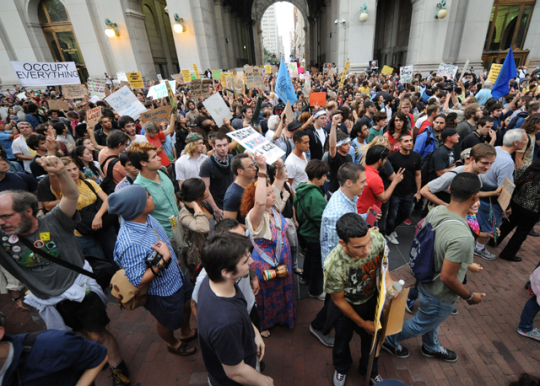
We have had enough. The people’s anger and discontent has passed simmering and is now at a low boil. OccupyWallStreet has given coalescence to all of the many disparate activist individuals and groups around the nation and a real movement has been born. People in Los Angeles, San Francisco, Baltimore, Atlanta, Seattle, Dallas, Milwaukee and other cities and communities have joined the Occupy movement, have joined their voices to rail against corporate control of our political system, our food supply, our media, our country. Our collective voice will grow louder, it will be heard in every state, in every corner of this nation. This is the time for Democrats to get on board, to offer their support, to own up to their responsibility to the working class. If they are not heard from very soon, it will be too late. This thing, this movement, is happening now, and it will grow and move and sweep this nation quickly. If the Democrats do not join with us now, we must either manufacture a much-needed, viable third party immediately, or else fire all of them and vote in our own representatives. The time for glad handing, for photo ops and back-room deals is over. We call on all Democrats in the House, in the Senate, and in the Oval Office, and we say: Do not rest easy in your big offices on Capitol Hill. This is your last chance. We will be heard, we will be represented. One way or another.
 True Left
I do have one question that I think is poignant, which has just occured to me recently:
Who are these people who “empathize with the rich” because they think that they, too, might one day be one of them?
I believe that notion is gone for the most part. I don’t know anyone who thinks that, not a single person. I guess there are the habitual lottery players, but I don’t really think they “believe” it, they’re just hoping really hard.
And then I have to ask of the very few who do believe, coming from where they are and looking around at the things they see, do they really have no desire if they get that lucky to do their fair share for society at large?
If the working man or woman today gets that lucky tomorrow, is he or she really going to say, “my former neighbors be damned?”
Is the person who relied on social welfare programs today going to say, “cut the social welfare programs for me” next week?
Is that what we have become?
I don’t know if I should say, “I doubt it” or “I hope not.”
“Where is Our Party” is an excellent piece of social commentary that really cuts to the chase! Brilliant analysis!
Yes indeed!
This brilliant analysis BEGS a thorough follow up with immediate remedial action.
Direct Public Initiative is the method allowing a states CITIZENS to solicit petitions to craft law in their OWN name! The sell-out politicians are foiled as Governors may NOT veto,nor legislatures amend those measures endorsed by public affirmation,once approved, repeal MUST be initiated
via the same route (public initiative) the measure became LAW!
24 states of the union plus the District of Columbia allow “Public Initiative” in some form.It comes as no surprise that NO southern state allows “Direct ballot initiatives” I hope and endeavor to see my state of Georgia adopt this “Direct ballot Initiative” process, and truly earn the designation “Empire state of the South” its long overdue. Justice Louis D. Brandeis once called “Public Initiatives” the most potent weapon for democracy in any states arsenal, I believe It’s high time we arm ourselves!